The Repair Shop is Missing One Thing

The Repair Shop has been wholesome, family-time appointment viewing in our home for some time.

But I find part of it VERY hard to believe.

No, not the show really being a set in a studio – it IS filmed in an actual barn out in the country with an excellent lighting system set up inside.

What I DON’T believe is the lack of swearing.

Yeah, sure, its a cozy, fuddly old BBC show, but the incredibly talented experts they use are craftspeople, workers.

They’re “Tradies“!

At no point in all the series we have watched has the expert, upon seeing the cherished family heirloom that found itself at some stage between a rock and a rhinoceros sucked a deep inhalation of breath through their teeth and said

“Yeah, it’s fucked, i’nnit?”

We have never heard a “SPROING!” “CRASH!“, or “CRACK!” in the background followed by a solid 15 minutes of foul language that leaves the neighboring farm owners questioning their real estate decisions.

We’ve never seen Kirsten muttering “shitshitshitshitSHIT!” when the glue hasn’t bonded properly on a Victorian vase.

Steve the horologist (clock/watchmaker) has never bellowed “Nobody bloody move!” after a spring has sprung off somewhere, or an irreplaceable, tiny screw was last seen rolling towards the Teddy Bear Ladies’ workstation.

Speaking of the Teddy Bear Ladies, they are lovely, but you can’t tell me that, in all their time making and fixing teddies and dollies, they haven’t at least TRIED making he occasional voodoo doll?

Has there ever been a passing shot of a small, fluffy replica of Jay (including felted flat cap) on a shelf, but the man himself is mysteriously absent?

All the experts are incredibly talented, skilled and professional.

But EVERYONE, from beginner to veteran, swears at some stage when they are doing intricate work and something goes sideways.

That’s what the show’s authenticity is missing.

Of course, this is all in jest. I do LOVE the Repair Shop.

They are not just repairing items, they are repairing memories.

They are repairing people.

It’s not an old radio they are hearing again, it’s their late father working in his shop.

The re-stuffed thread-bare teddy bear was someone’s only source of cuddles through hard times.

They’re not just craftspeople, they are therapists.

But can we PLEASE have some swearing, just for authenticity sake?

Even in the end-of-season outtakes?!

Will the chippy and Dom the metal worker, I’m looking at you out of sheer tradesperon stereotypes.

Even if it’s Pete, the brass and percussion instrument expert declaring in his deep London drawl “that sounds fuckin’ brilliant!” upon a cherished trombone or trumpet finding its voice again for the first time in decades.

There’s a Hole in My Roadway, Dear Liza, Dear Liza

Recently I went for a walk through a hole.

That may not sound frightfully thrilling, but I found it really interesting!

That’s because I’ve watched the progression of this hole for weeks.

Down the road from where I live one of Napier’s main arterial routes, Taradale Road, has been getting dug up, had large metal plates and piles driven beneath it – the sound of the piledriver at times not too dissimilar to a church or clock tower bell (except I am unaware of the time “72 to 14 o’clock”..) and large concrete culvert blocks being lifted in and slid underneath it.

Such large excavations required lots of support. Dozens of long, metal piles have been driven into the creek bed to support the work’s walls

All this activity – The stuff of Tonka truck drivers and Lego builders’ dreams is to aid the flow of the Georges Drive creek and lessen the chances and effects of future flooding events along its path.

The creek has a long, aquatic pedigree. Before Hawke’s Bay’s 1931 Earthquake and subsequent urban development, the path that it takes from Chambers Street behind Napier Boys’ High School, along between Georges Drive and Douglas McLean Avenue and passing under Taradale Road, used to be the course of the Tutaekuri River that now flows behind Taradale.

Tutaekuri River, Napier, 30 March 1922, Napier, Looking from what is now Pettigrew Corner and Roundabout southeast towards Napier South. Photo by Leslie Adkin. Te Papa (B.022330)

On 9 November 2020 parts of Napier were inundated by flooding, much of which happened in the suburbs of Marewa and Maraenui, along this creek.

While where I live was fortunately spared from the flooding, it was only just so – because the river/creek bed is trapezoid shape, for every meter the water rose up, it had to go five, 10, 20 meters across – The creek level outside our house still got to within a meter of breaching onto the road. Needless to say that ends up being A LOT of water!

And that was a major part of the problem. As once all that mass of water got to the crossings at Taradale Road and Herrick Street, there were only single, concrete culvert pipes, about one meter in diameter going underneath each road. That massive amount of water didn’t go through those small pipes anywhere near as quickly as it needed to.

Stormwater pipes along the length of the creek adding even more rainwater into it, and tides at the creek’s outlet into the estuary effecting its drainage just exacerbated the flooding upstream.

The south side of the Herrick Street culvert showing the size of culvert pipe pre-redevelopment

So, when Napier City Council announced they were going to be increasing the size of these culverts, my main thought was “by how much?”.

It turns out the answer was “LOTS!”

The old half of the Taradale Road culvert (around one meter in diameter) framed by the new half of the culvert – approximately SIX TIMES bigger!
Photo courtesy of Napier City Council

It turns out lots of locals were also interested in the work. About 50 people turned up on a sunny Saturday morning to walk around, and through, the culvert work. I was part of the second group to tour the site with Napier City Council and Fulton Hogan staff talking us through progress.

As we walked through the new culvert sections, I had to get an idea as to their size. I’m a tad over two meters tall (yes, REALLY!). With my arm raised above my head, touching the top of the culvert indicated it’s about three meters high. The culvert is around twice as wide as it is high, so three meters by six meters is significantly larger than the original one-meter diameter pipe!

Scoping the size of the new Taradale Road culvert. Two meter tall author for scale.
Photo courtesy of Napier’s Mayor.

You might wonder how we were able to walk through a creek culvert without being waist-deep in water, weeds and inquisitive eels? Well, part of the works has involved damming either side of the culvert, with diversion pipes helping keep at least some of the creek’s flow going.

The bottom of the new culvert is actually below the current creek bed level. There are plans for the creek bed through the culverts to have rocks added and ultimately make the area as natural as possible for the wildlife, which includes eels, ducks, shags, herons and occasionally spoonbills, that live in the creek.

A pair of heron on their way back from inspecting the culverts works.

I will be interested to see how the bigger culverts effect the creeks flow.

I would expect the regular depth to possibly drop a bit, given the bigger pipes allowing more water through more regularly. But the added volume currently backed-up on the Kennedy Road side of the Herrick Street culvert flowing through more freely might equalise that out.

There might even possibly be more of a tidal effect from the Ahuriri estuary nearby (there are already, albeit slight, inward and outward tide movements in the creek, along with the occasional school of mullet or similar fish who come for trips up-stream.

Whenever the next significant rain event happens once work is complete I’m confident the creek level won’t get as high as 2020 again. The increased flow rate will be interesting to see, though.

The current, regular, height of the stream.

Water Flow vs. Traffic Flow

I do have one concern about the Taradale Road culvert redevelopment, but it isn’t about the construction.

Hawke’s Bay drivers are notoriously BAD. Anyone who has driven on our roads for a while will know that situational awareness, courtesy, and an ability to follow road rules can often be lacking to say the least.

Can’t park there, mate! In 2024 a car ended up in the creek where Alpers Tce and Douglas McLean Ave meet. No. I don’t know “How?!” either…

Hell, two cars crashed through barriers into the Taradale Road culvert work site one night, one almost falling into the large freshly-dug cavity where the second half of the culvert is due to go!

But back to my concern: During the redevelopment of the Taradale Road culvert, hill-bound traffic has had right of way (mainly because it allows Napier’s Fire Brigade, stationed right next to the roadworks, quick access to the city centre). This has included hill-bound traffic crossing to the opposite side of the road while the second half (Kmart / Mitre 10 side) of the culvert was being laid

Meanwhile traffic that usually turns left at the Taradale Road roundabout at the base of the hill to go towards Onekawa and Tamatea has been blocked and had to detour via Georges Drive, Herrick Street and Douglas McLean Ave/Alpers Terrace, or Ford Road between Kmart and Mitre 10.

When the culvert work is finished, and Taradale Road reopens in both directions, I can see this causing some problems, and probably a few accidents.

Because, at the corner of Taradale Road and Alpers Terrace there is a Stop sign and two yellow lines across Alpers Terrace. Not that you would know it from standing at the bus stop in front of the fire station, watching the corner.

Some people stop, but most drivers seem to consider it a “Give Way” at most, or just blatantly ignore it. This has made the corner a site for regular motor vehicle accidents for years.

I fear several months’ construction and accordingly altered traffic flow will only make the frequency of crashes on the corner spike once regular two-way traffic is reinstated.

With no Onekawa-bound traffic crossing their path, vehicles turning left from Alpers Terrace into Taradale Road have not needed the regular awareness of cross-traffic to their right and months of thinking they (‘still’?) don’t need to obey the Stop sign at the corner.

Equally, those currently turning right unencumbered from the fire station side of Taradale Road into Alpers Terrace will likely get a sudden surprise to discover traffic coming towards them once again halfway through their turn.

I outlined these concerns to the Napier City Council comms people at the tour, so it.will be interesting to see what sort of publicity or guidance there will be in.the lead-up to Taradale Road fully reopening once again.

The last thing we want after months of constamt construction closure is months more of sporadic crash-related closures and disruptions!

Priming the Optima

After building a couple of Tamiya TT-02 radio-controlled cars recently, I wanted to try something different and perhaps harder.

Cool Toys in Napier had a very cool looking Kyosho Turbo Optima on display for some time. It had brass and metal parts and, being Kyosho, was known for high quality Japanese production.

I had seen a couple YouTube videos of the kit being put together, which sealed the deal – When I had some spare disposable income I bit the bullet, well brass bits at least, and bought it.

The kitset sat in my garage for almost a year, as I needed the time, desk space and will to build it because, once opened, the kit seemed quite formidable (and not just because half the sizeable instruction manual was written in Japanese Kanji.)

Fortunately all I had to do was follow what was written in typical, locigal Japanese efficiency on the cover of the manual:

“Before beginning assembly please read these instructions thoroughly”

I was made redundant from my job of 21 years in November, so suddenly.had a lot of spare time.

Just not immediately.

After helping out at school camp, umpiring a Cenrral Districts age group cricket tournament and getting through Christmas, I opened the first parts packet and put the first sections (drive belt and differentials) together on New Year’s Eve, 2025

Purposefully plodding through the pages saw the sleek steel buggy slowly come together.

I had a few moments of blind panic, where it turned out I had bolted bits together in the wrong order, or around the wrong way.

On one occasion a screw decided it did not like the idea of being un-screwed and allowing me to turn one of the main chassis frame braces 90 degrees into its correct position. I ended up having to undo the parts around the brace, pull it out and spin the brace around the screw to undo it.

The offending screw then went happily into its right-angled home without protest.

<SIGH!>

It was very easy to feel overwhelmed doing this build – It was so much more advanced than anything I had previously built. There were so many small parts, so much that could go wrong.

I had a couple of moments when tiny metal “C-clips” when flying. Fortunately the Model Fates were smiling upon me, as they either landed back on the work surface, or fell straight down to my feet.

In all other situations it was a case of:

“Before beginning assembly please read these instructions thoroughly”

I swear that is basically Haiku (with a few spare syllables)!

Building your own oil-filled, pneumatic shock absorbers was a new experience, too.

After the stress of errant airborne C-clips, it didn’t seem so hard taking a couple of attempts to get the right amount of oil in each tube to ensure a flat, level buggy and easier steering once it got running.

As the car got bigger and the pile of parts bags got smaller building continued to be unexpectedly easy – With much of the chassis built, other parts needed to be added internally, but preset holes and spaces made for easy access to add the final bits and pieces.

With the chassis as complete as I needed it was time to start painting the body.

The Optima actually came with a driver, so I started with that to reaquaint myself with painting clear polycarbonate inside out.

It also gave me a good use for the spray paint left over from painting my precious Tamiya RC cars – At least one of the cans ran dry on the last driver coat!

With the driver painted and decaled it was onto the body. After cleaning it with warm water and dishwashing liquid then drying thoroughly to get rid of any casting residue and ensure the pain would adhere properly, it was time to mask the body.

And mask.

And mask.

The box art had the car in only two colors – Red and White, but making sure the lines were crisp and defined, without any colour bleed was essential, hence the truckload of masking tape.

Fortunately Kyosho provides several sheets of pre-cut masking for windows and side pods.

With the Optima’s body successfully painted and the wheel arches cut out, the last stage involved lots of decals, giving the buggy an authentic racing look:

Overall, the build was a great experience once I got over the enormity and complexity of a multi-paged, kanji-filled instruction manual.

All I had to do was work slowly and read the instructions thoroughly!

Postscript;

My goal with the Optima was to build something I’d never made and challenge myself in doing so.

Having met the challenge, the Optima is now back at Cool Toys in Napier because, frankly, six months after being made redundant, I need the money from a completed RC kit more than I need the car, awesome as it is, in my collection.

If you are interested in giving it a new home, and/or blasting it around some tracks, get in touch with Glen!

Hawke’s Bay’s Biggest Fans

Hawke’s Bay has become a real technological hub.

For decades leading-edge agri-tech has been developed on the Heretaunga Plains to aid its farmers and growers.

Rockets are regularly launched into orbit (and to the moon) from Mahia Peninsula, and last year, with Meridian opening its new Harapaki Wind Farm on the Napier-Taupō Road, Hawke’s Bay now has its own renewable, environmentally friendly power-generating site!

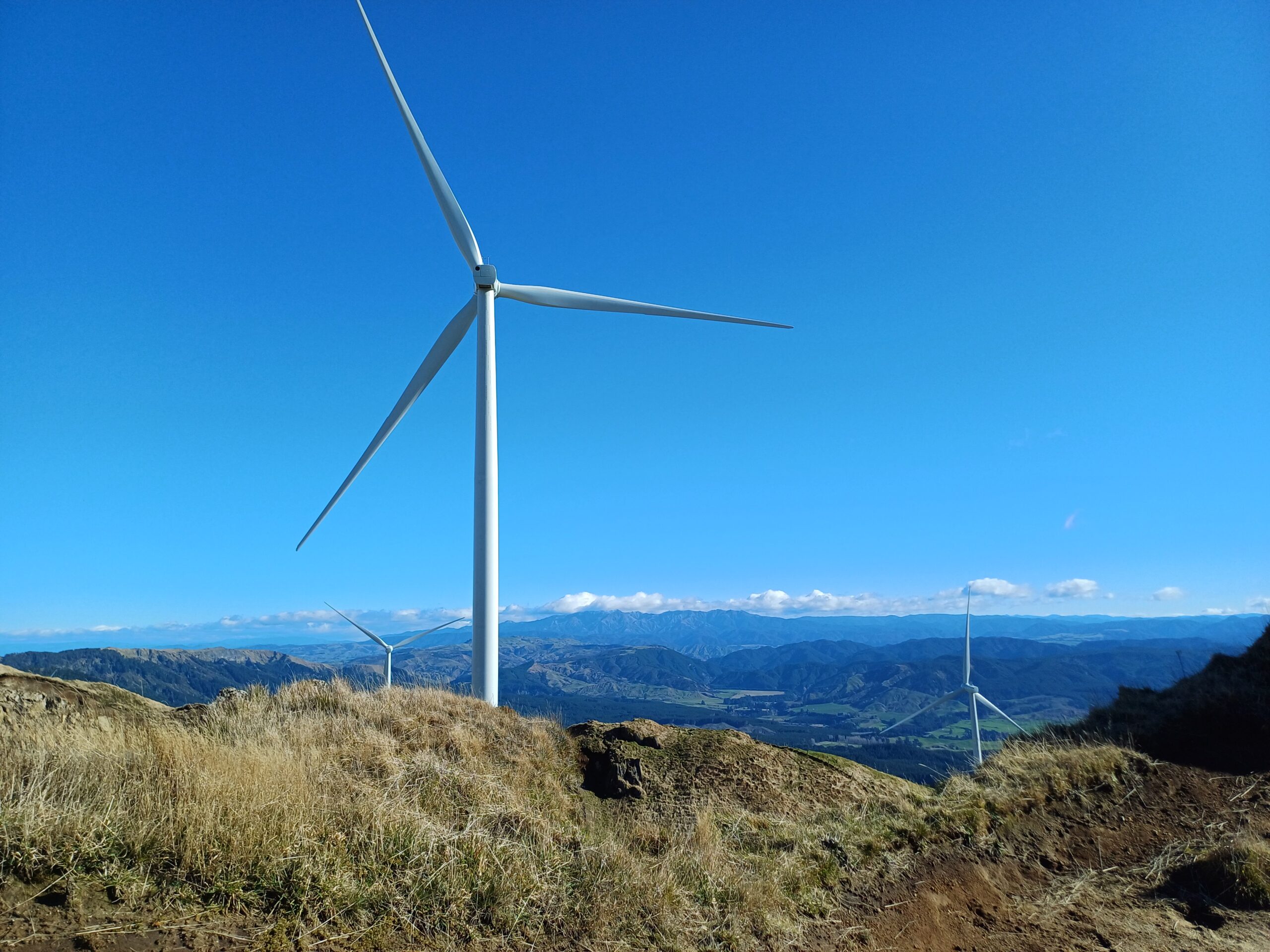
Covering 10 square kilometers along the top of the Maungaharuru Range, just north of Te Pohue, Harapaki is New Zealand’s second-largest windfarm. At roughly 1,100 meters above sea level, it is also the country’s highest.

It was fully commissioned by Meridian in July 2024 on time and within budget. In its first full week of operation Harapaki exceeded 170MW of generation several times and set a new Meridian record, with a daily mean of 156.6MW produced.

One thing that makes Harapaki special is its wind turbines – they’re Siemens direct-drive Typhoon-class turbines with no gearbox between the blades and the generator, making them more efficient and reliable than other turbines.  

Typhoon class turbines were originally designed for offshore wind farms and require less maintenance. This model of turbine is available only in New Zealand and Japan” says Chris More, Meridian Energy’s Head of Renewable Construction and Harapaki project overseer.

The Harapaki Wind Farm can produce a maximum of 176 megawatts of renewable energy, which is enough to power over 70,000 homes – roughly the equivalent of every household in Hawke’s Bay.

Harapaki will not, of course, be a power producer for our region exclusively.

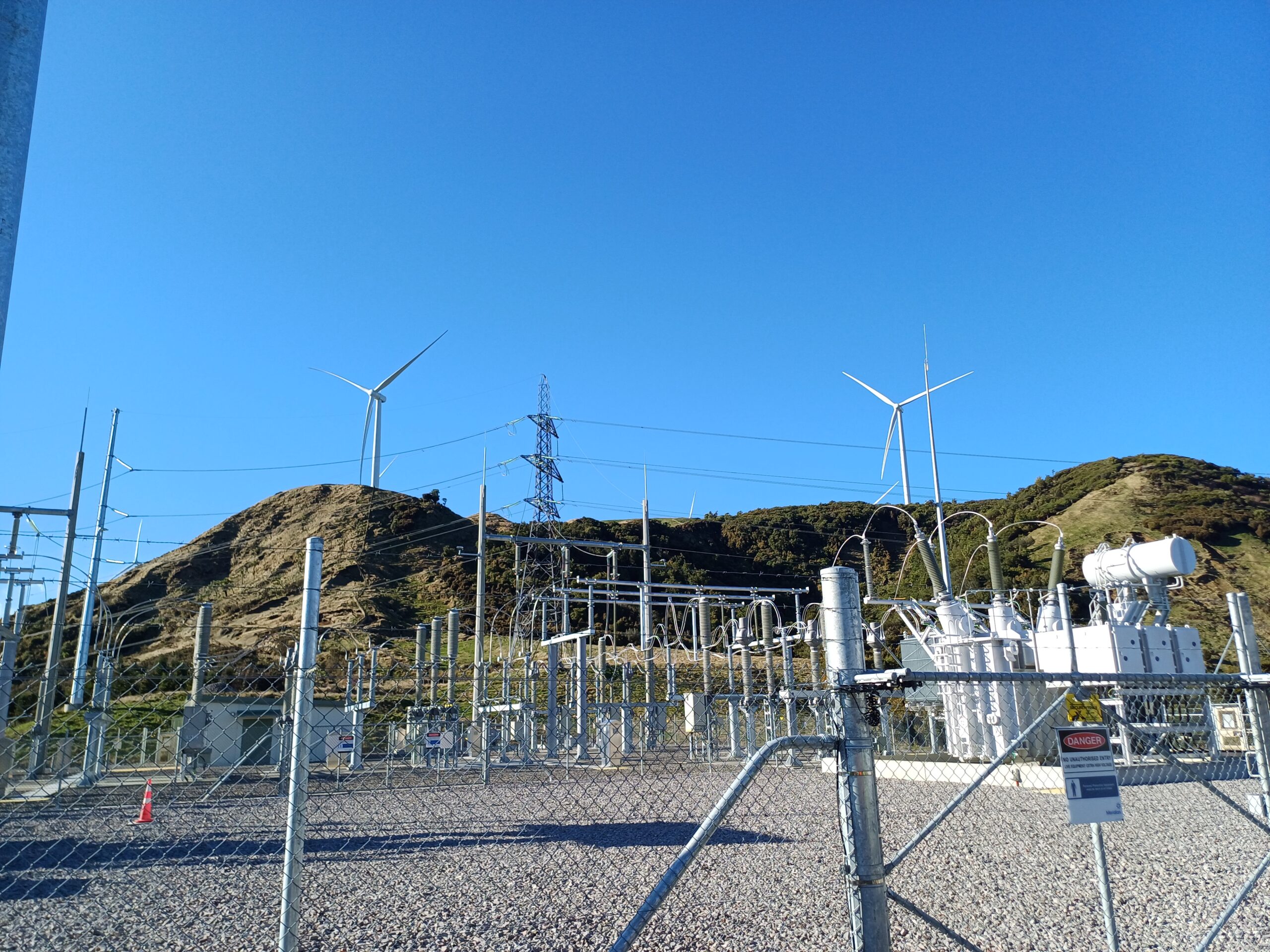
Its location is adjacent to Transpower’s national grid lines that run between Wairaki, near Taupō, and Redcliffe, on the outskirts of Taradale in Napier. This means it can provide much needed power supply resilience to the North Island and beyond.     

As anyone who had to wait for just one of the wind turbine blades to pass while they were being transported by road from the Port of Napier to the Harapaki site will know, these turbines are HUGE!

The towers alone are 85 meters high, and the diameter of the blades’ rotation is 120m. From ground to vertical blade tip, they stand 145 meters high – it’s no wonder you can see them from as far away as Napier!

Shortly after it was commissioned, Meridian’s Lachlan Forsyth (formerly of the legendary Campbell Live show) invited me up to view the wind farm first-hand. To see these 41 giant wind turbines up-close on site and stand underneath one of them while it slowly spun made even my 6’8” tall frame feel tiny.    

By the People, For the People

Construction of the Harapaki Wind Farm involved a million “man-hours” of work, with around 2,500 people inducted onto the site during the project, roughly half of those being workers from Hawke’s Bay. The on-site security who greets you when you arrive on site are Te Pohue locals.

When Cyclone Gabrielle hit the region in February 2023, Meridian used the resources available on site and through their company’s networks to assist locals. That included flying in much-needed supplies and redeploying the site’s earthmoving equipment to help with clearing parts of State Highway 5 that had been blocked or washed out by the storm.

Meridian aims to assist locals further with its “Power Up Fund” which provides financial support to community groups in areas where they generate power. It allows community groups to apply for grant funding that can go towards things like community swimming pools, firefighting equipment, tree-planting and other local initiatives. “Harapaki shows we have the capability to deliver. We’ve got a world-class renewable construction team backed by a great group of contractors. What they’ve achieved in the face of COVID-19 and multiple weather events is truly outstanding,” says Guy Waipara, Meridian’s General Manager Development.

Have a Look at Havelock!

Wonderful, Wordy Wardini Books!

Recently Mrs. in Frame and I reached our 20th wedding anniversary.

After staying there earlier this year, we decided to have another weekend “Staycation” at the Enchanted Retreat in Havelock North to celebrate.

The Enchanted Retreat, Havelock North.

We here in Hawke’s Bay are SUPPOSED to be very parochial – Hastings vs Napier and never the twain shall meet, etc.

The truth is in recent years rather than being disparate regional towns, Napier and Hastings and Havelock North (calling “Havvers” a “Suburb of Hastings”, while technically correct might get you run out of town) have all essentially socially merged to be one big urban base. It doesn’t take more than half an hour to get from one side to the other – no different (possibly quicker?) than going from Mount Eden or Newmarket to Ponsonby in Auckland and with different facilities in each city commuting between the metropoli has become as common as going from Taradale to Tamatea.

The distance and differences, while smaller than before, are still interesting, giving us unique experiences without having to go too far afield.

We arrived at our glamping retreat on a chilly Friday evening and with gas fire and air conditioning going dozed off looking at the lights of Hastings and Peka Peka in the distance.

The next morning, we received two platters which are among the options the retreat provides – First, breakfast!

Bagels, fruit, muesli, bread, pancakes and smoked salmon for a healthy and fortifying start to the day.

Not long after, our picnic lunch arrived – Containing rolls, slices, cheeses, salad and pate!

I ducked into Havelock North village’s shops to get some of our daughter’s favorite sushi from Sushi Ten (a regular destination when it was previously in Taradale), and naturally had to stop in at Wardini Books.

On Saturday afternoon, after our platter lunch and a ruminating soak in the hot tub, we went for a lovely walk through the Karituwhenua Stream walkway / Kingsgate Reserve.

Stepping off main arterial route that is Te Mata Road it doesn’t take long to not feel like you’re still in suburbia, with lots of flora and native birds like Tūī and Pīwakawaka swooping and singing in the trees, all the while with the gentle sound of the Karituwhenua Stream running through the middle.

Walking up one side of the stream to the top of the track and back on the other side took a leisurely 45 minutes to an hour, after which we went for a quick peek at the “Wooly Coos” – highland cattle that live in front of Te Mata Estate Winery.

Karituwhenua Stream walkway / Kingsgate Reserve Te Mata Road, Havelock North.

We headed back into the village for a quick, early dinner at Mary’s.

We started with a Mojito and non-alcohol “NOjito” mocktail while our meals were being prepared. One thing I have done on these staycations is try things I have never or wouldn’t usually have.

For mains I had Beef Short Rib Croquettes with Harissa Mayo and Roasted Vegetable Salad, Whipped Feta & Pomegranate Molasses Dressing, while Mrs. in Frame had Pan Seared Fish Fillets, Pickled Vegetable Escabeche and Saffron Mayonnaise.

Everything was delicious!

Our last morning in Havelock North dawned with a stunning foggy outlook across the Heretaunga Plains.

Looking towards Peka Peka reminded me of looking across Hawke Bay from Hardinge Road in Ahuriri, Napier, to West Shore, with a foggy sea reaching out to the ranges.

From our accommodation in the Te Mata foothills we caught the briefest of glimpses of foggy coverage all the way out to actual Hawke Bay as we headed into town for a breakfast coffee at Workroom and pastries from Wright & Co.

Fog covers the Heretaunga Plains looking south-west to Peka Paka

We thoroughly enjoyed our second local staycation this year and would absolutely recommend visiting our Hawke’s Bay neighbor, Havelock North, and staying at the spectacular Enchanted Retreat whether you’re a local looking for a short break or visiting our awesome region!

A Dad-less Decade

I miss you, Dad.

It’s a decade since you left us.

Ten years.

A lifetime.

Your granddaughter’s lifetime.

I know you were already so proud of her in the little time you had together, but you would be even more so now.

She’s smart, kind, beautiful – Just amazing!

I’ve long said the only thing I wanted to be in life was as good a father as you were – You set such a high standard by just being you – Kind, caring, loving, supportive.

I ask my daughter if I’m a good dad and she says I’m the best, so I must be doing something right. And I just do those same little things, too – Be supportive, loving, help out.

There has been a lot of that over the years:

  • Taking her Kiwi Cricket team throughout primary school – Not because I wanted her to play cricket – She wanted to play it because I do.
  • Always going to her sports/gymnastics/dancing/aerials practices and performances.
  • Going on school outings and camps.

I’ve (humorously) convinced her that there is a “Parenting Rule Book” (‘Rule One, Line one, Page one: “You MUST embarrass your child at every opportunity”!’), but we all know there is no such thing. It’s always been almost purely seat-of-your-pants stuff, hasn’t it?

Growing up sometimes a safe, happy, loving home is all you need. I was very fortunate that mine was.

I still wish you were here to lend a hand, give advice from when I was her age, or just tell me I’m doing OK.

Because as you get older it seems like you’re constantly told you’re wrong (even when you aren’t), but so seldomly told you’re doing well.

It starts to drag you down after a while.

While you were my hero and I aspired to be like you, I don’t want to be EXACTLY like you.

I remembered when you got made redundant from the NZED in my last year of primary school.

Last year was your granddaughter’s last year of primary school, and while I wasn’t under threat of redundancy, unlike so many thousands of public servants last year, I still felt lost and trapped after commemorating 20 years in the exact same job with no advancement, which has hindered the search for new jobs.

Feeling guilty that you have a secure job that is slowly driving you mad when others are losing their income source is rather brain-busting.

But it has had advantages – My work doesn’t care about developing me, so I’ve taken every bit of leave I can to help my daughter develop and experience new things.

The absolute best parts of last year were being one of the parents that accompanied her year group’s camp to Wellington for a week, and helping out when her class went sailing on Ahuriri Estuary.

Such brilliant kids!

I just hope we can provide them with the future they deserve, not the imminent apocalypse our current crop of global leaders appear hell-bent on driving us towards just to benefit their own financial enrichment.

I’m not sure what you would have made of a global pandemic, Cyclone Gabrielle cutting Napier off from the rest of New Zealand for a week, or current global politics.

I doubt Mum could have coped with the stress of the pandemic alone.

Did you get to see Mum again?

I like to think I saw the two of you together again, in a way, the morning after she died.

I hope she’s happy wherever you are if that is the case.

This year will be my 20th wedding anniversary.

You two made it to 37, but we had a 13-year head start by comparison.

Like parenting I wonder how we do it sometimes. A few of our fellow school year’s parents have parted ways since primary school started.

Similarly, we don’t make anywhere as much as other families, yet still somehow manage to live comfortably on a single income like our family did growing up when others I know are earning far more individually and are on two incomes yet still seem to struggle.

I sometimes wonder if we are doing something right or wrong.

Admittedly, unlike us, most of them have more than one child, and I guess the extra costs and things like childcare must be taking a lot out of that income.

You never really know what others are going through, eh?

Do you hear me when I talk to you? I do it almost every day.

Asking your opinion, guessing what you’d say in similar situations, apologizing when I stuff something up.

I spent about 80% of my time quietly muttering “Sorry, Dad” while clearing out the garage and your shed of all the will-be-handy-some-day stuff you had collected over the decades when I was getting our old home ready for sale.

In the end there was a couple hundred dollars’ (and kilos) worth of metal, brass, nuts and bolts, old nails, copper pipe, wire and electrical bits and bobs across the various sheds and back yard that I took to the metal recyclers.

There was a lot of heavy physical lifting, and a lot of emotional weight – So many memories in those sheds.

I kept a lot of your hand tools, and those little plastic drawer sets full of new, unused nails, screws, rivets, etc.

I figure they will be handy someday…

I even repurposed some of the recycled native wood you had lying around into frames for some of the other gems I discovered.

It felt like a very “Dad” thing to do.

Speaking of making things you’ll be pleased to know your skilled woodworking genes that lay dormant for most of my life have finally kicked into gear!

The sheds are all gone now. And so are the back yard’s old features – The rotary washing line, the ancient lemon tree, the camelia you successfully moved from one side of the yard to the other. The tree outside your shed you would work in the shade of (I’ve kept bits of that for various modeling projects, so its memory lives on).

I’ll be honest – Even as a grown-ass 47-year-old I’m still struggling emotionally with losing my childhood home.

It gives us financial freedom and secures my family’s future (for a while at least).

That feels like a very “Dad” thing to do, too.

But it feels like I’m losing a bit more of you all over again.

A week or so after you died, I crumpled onto the floor where my wife was feeding our daughter because I realised I’d never get to hug you ever again.

Ten years later I could still really do with that hug.

Miss you, Dad.

Love you.

Andrew

Twelve Days of Christmas Deliciousness 2024 (Kiwi) Edition!

The inspiration: A Pukeko in a Ponga Tree
Adapted by Kingi M. Ihaka and illustrated by Dick Frizzell

For almost 20 years now, Mrs InFrame has been coming up with a special 12-day menu to celebrate the “Twelve Days of Christmas”.

While the “Twelve Days of Christmas” traditionally starts on Christmas Day (December 25) and runs through to 5 January, we usually do it as a countdown to Christmas – It just happens that this year we were really busy, and I wasn’t able to get the list out until the end of the traditional 12 days.

My wife alternates each year between the traditional and the New Zealand version, otherwise known as “A Pukeko in a Ponga Tree”.

This year was the Kiwi Christmas Deliciousness Edition.

The dishes usually have a direct correlation to the songs (Five Big Fat Pigs = Pork/Ham/Bacon), others use a fair chunk of artistic license as, if we stuck COMPLETELY to the original “Twelve Days” song’s days’ feathered features, we’d be swimming in poultry with French Hens, Swans a Swimming, Geese a Laying etc. etc. otherwise.

And while the fast-food chain Colonel Harland Sanders’ founded predates even McDonalds in New Zealand, so it holds a special place in our nation’s stomachs, I don’t think a “12 Days of KFC” would be dieticianaly advisable.

I’ll do my best to explain the pairing concepts as we go.

So sit back and prepare to adore what my true love made over the Twelve Days of Kiwi Christmas Deliciousness 2024

A Pukeko in a Ponga Tree

Broccoli & Anchovy Pasta with Blueberry Smoothies

Pukeko, otherwise known as the “Australasian Swamp Hen”, are blueberry-colored birds that live in or near creeks and wetlands. where they can feed on tiny fish (like anchovies). The penne pasta looks like Ponga logs, with the broccoli representing the ferny plume of the Ponga tree.

Two Kumara

Baked Kumara with Mole Sauce

Kumara are a sweet potato. For this dish we baked kumara, filled if with vegetables and chocolate mole sauce, which can represent the dirt or mud kumara are dug out of.

Three Flax Ketes (“Kits”)

Black Cake with Cream and Purple Sprinkles

Harakeke is the New Zealand Flax plant. It can be woven into kete (carry bags) and is also a food source for the Tūī – a native New Zealand bird with black-blue-green feathers and a white plume under its neck.

This is where the inspiration for this dish lies – Black Cake (like the feathers), with the cream and sprinkles representing the plume and blue-green hues,

Four Huhu Grubs

Prawn Mousse Filled Pasta Shells

Huhu grubs are a creepy crawly larva-like delicacy usually served at most “Wild Food” festivals. They are renowned for their gooey-squishiness when you bite into them.

The ribbed pasta shells resemble Huhu grubs, with the Prawn Mousse and Marinara Sauce giving them their squishy centre.

Five Big Fat Pigs!

Battenburg Cake

The pink outside of the plump Battenburg Cake represents portly pigs. The rich, sweet, chocolate cake that makes part of the cake began its life as a “muddy” mix, which pigs like to wallow in.

Six Pois a Twirling

Vegetarian Spaghetti and Meatballs

Poi are little bags on woven string used in Māori dance and cultural performances.

We think these mushroom balls look like Poi, E(h)?

(We only had enough spaghetti for my wife’s dish, so I had these smaller penne rings)

Seven Eels a-Swimming

Sushi

The Longfin Eel are native to New Zealand. and can be found in lots of muddy waterways – even the creek that runs past our house.

The Māori name for eel is “Tuna”, which is why Mrs. Frame had tuna sushi.

I had Katsu Chicken sushi. pictured above) with its nori seaweed wrapping looking like an eel wrapped around lettuce looking like waterway greenery.

Eight Plants of Puha and Nine Sacks of Pipis

Citrus Lymph Flush and Seafood Pizza

Puha is a leafy, green, wild vegetable that usually grows in or near waterways, so a detox drink made of verdant fruit and veges matches the liquid and color categories.

Pipis are bivalve mollusks like cockles. We kept the aquatic theme with seafood pizza.

Ten Juicy Fish Heads

Crab Stick Dogs

Despite the name, Crabsticks are usually made out of fish. Deep fried in batter they become very juicy. With some coleslaw salad and sauce the dogs got even juicier!

The addition of half a scoop of chips was just a given.

Eleven Haka Lessons

Roast Pork and Vegetables

The Haka is synonymous with Māori culture. 

A fantastic Māori cooking method is the Hāngī – cooking food using heated rocks buried in a pit oven, called an umu.

The foods Mrs. Frame used in this (above ground) roasted dish – Pork, Kumara, Potato and Pumpkin – are all typical ingredients in a Hāngī.

Twelve Piupiu Swinging

Pastry Wrapped Sausages

Piupiu are a Maori grass skirt, as can be seen in the iconic Poi e music video mentioned above. When the dancer wearing it moves the individual threads spread out and sway.

We have made these pastry-wrapped sausages several times before, usually around Halloween and called them “Mummy Dogs”, as, like piupiu, we cut the pastry into long strips, which we wrap around leg-like sausages.

We hope you’ve been inspired to try some of these, or your own version next Christmas.

From the Napier in Frame family to yours, we hope you had a Merry Kiwi 2024 Christmas and will have a safe and happy 2025 New Year!

Sink or Schwimmwagen

As an avid young scale modeler in the 80s/90s, one of the best parts of any year was when the Tamiya model catalog came out.

The catalogs featured new scale models, radio-controlled stars, and some of the most stunning dioramas ever captured on film!

(The smell from the dozens of full-gloss printed pages was guaranteed to keep your sinuses clear for months, or get you addicted to the smell of model glue and/or paint…)

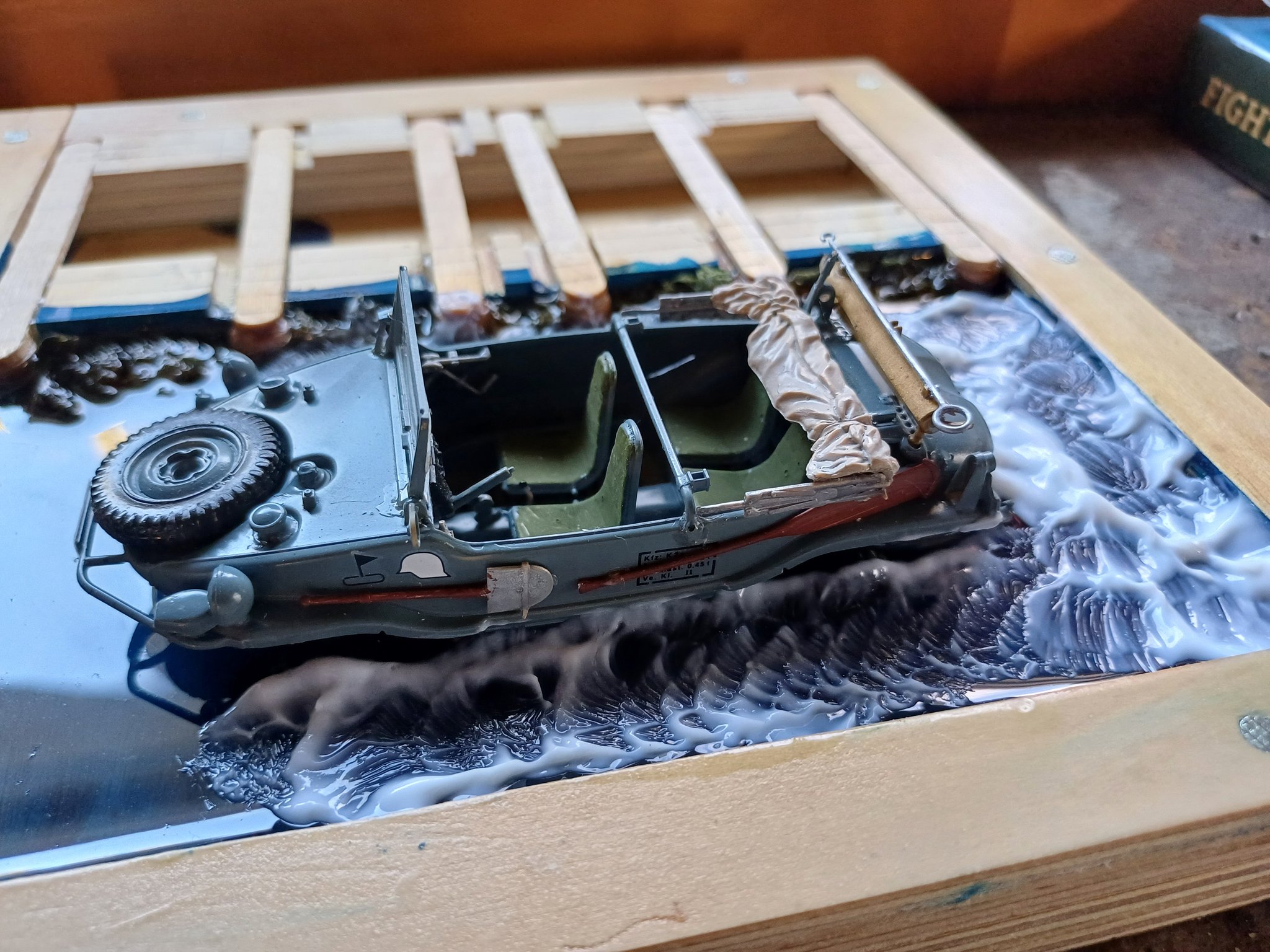
One of the earliest, coolest dioramas I can remember was a WW2 German Volkswagen Schwimmwagen amphibious jeep fording a river.

I never had the skill to recreate the scene myself as a young one. But the more modeling I did and the different methods I had started trying recently gave me the confidence to try it out.

I bought a 1:35 Tamiya Schwimmwagen and Italeri Willy’s Jeep from my regular Napier model store, Cool Toys, and got to work

Image

This was going to be a bit of a higgledy-piggledy process, because there were going to be a few changes that I wanted to make, so I painted and glued together what I could initially without causing too much hassle down the line.

Image

To make the Schwimmwagen look like it was…erm.. “schwimming” I either needed a lot of resin (which I didn’t have) to make a deep river or cheat a little by making the wheels a bit shallower.

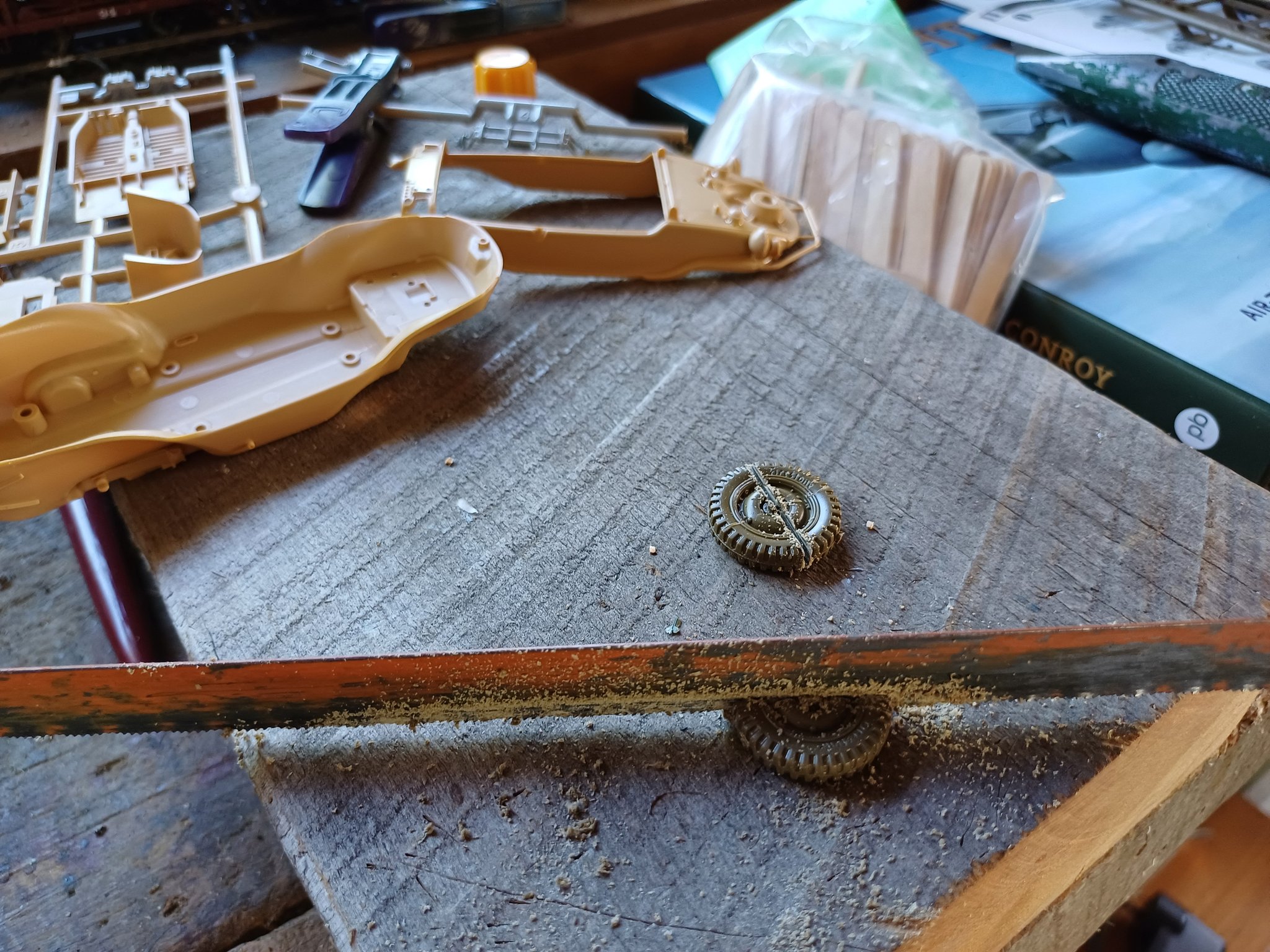
Fortunately the Jeep kit also came with a trailer I had no intent on building, but the spare two wheels (olive green, on top of the original sandy-colored Tamiya wheels, above) would certainly come in useful.

Rivet-counting model prototype purists may cringe, but I was working on the theory that very little of the wheels would be visible above “water-level”, so it didn’t matter so much.

Image

To make the Schwimmwagen sit flush with the base I was doing to pour the river into I had to do a bit of “kit-bashing”. This involved a hacksaw.

Image

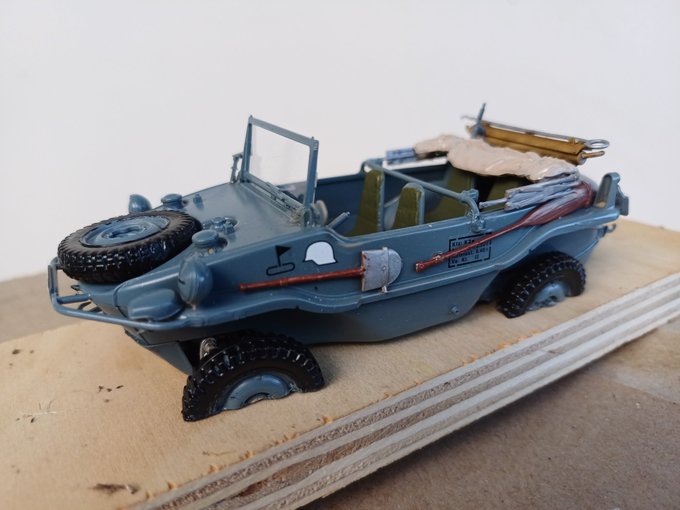
With the kitset put together, painted and decaled it looked pretty great!

Now onto the Jeep!

Image

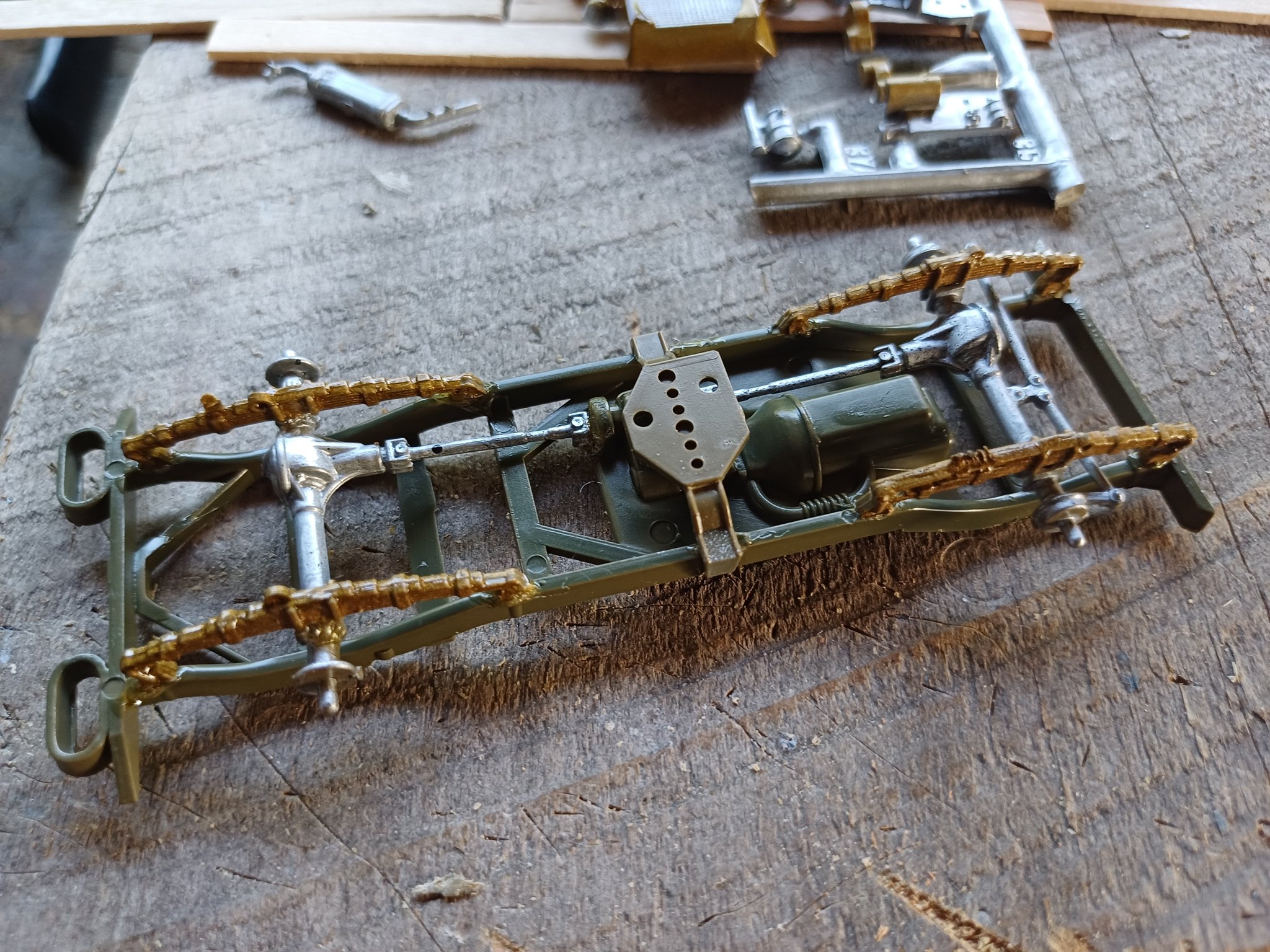
I painted most of the parts on their sprues and started with the chassis and suspension. With very few issues, aside from a couple of fit issues the kit came together quickly and easily.

Image

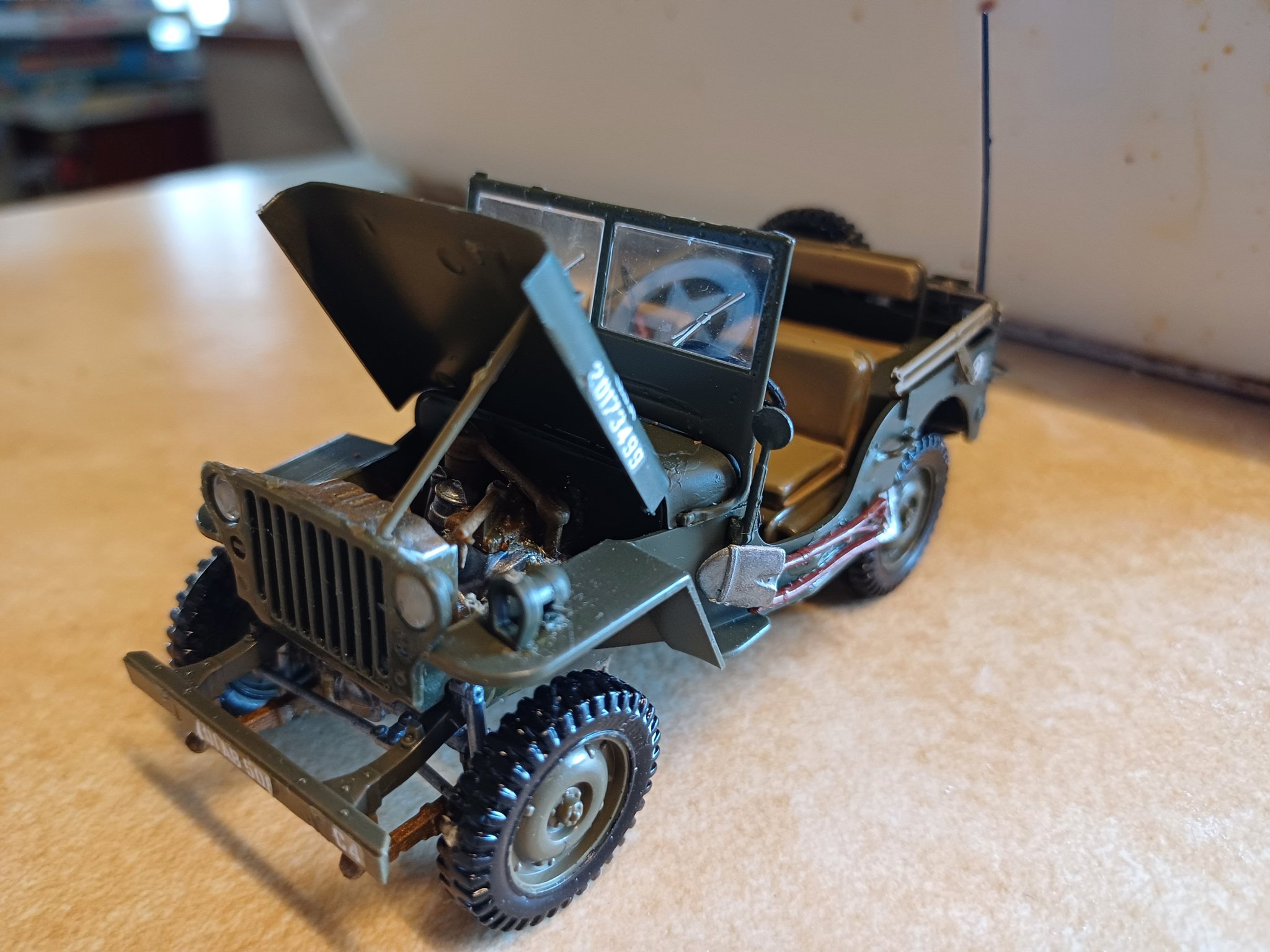
As part of the diorama, I intended the Jeep to have its hood up, possibly with a figure working on the engine, so I made a point of painting the engine, and detailing the engine bay a bit too.

With the kits completed I moved onto the base.

Image

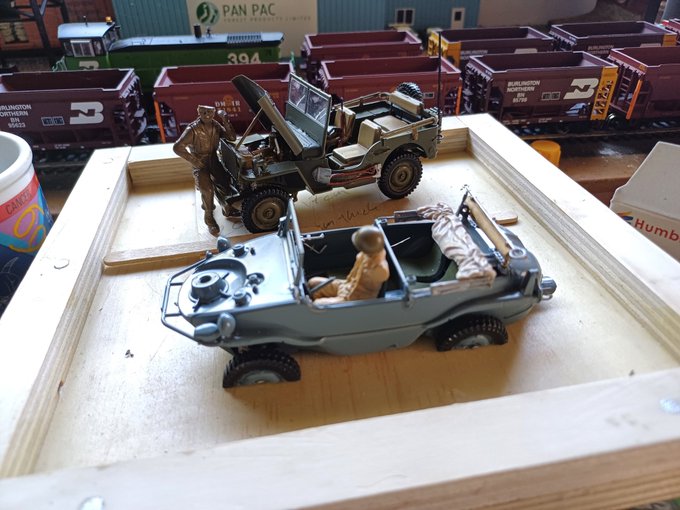
For my diorama I intended a purloined German Schwimmwagen to be cruising past a Jeep on a wharf with engine issues.

I made the base out of scrap plywood from the bat case I made last year.

I sealed and painted the “water” area, and prepared the “piled” wharf base.

Image

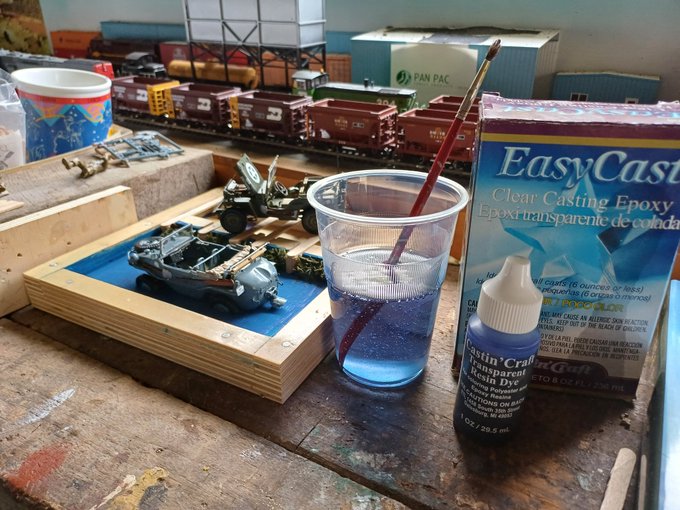
I got to use the remaining half of the resin I bought to make the sea for my “Spit in the Sea” diorama two years ago which had, very thankfully not gone off or hardened in the meantime, mixing the resin together and pouring it into the “lake” section.

The amount of resin I had filled the “lake” perfectly, right up to the level I wanted (this had required a bit of mathematics to figure out).

I left it for a couple days to harden properly.

Image

To give the Schwimmwagen a “wake” to give the impression it is motoring along I used gel medium (also from the “Spit in the Sea” diorama) to make some waves.

To make the wharf I cut dowel down into sections to make the front of the wharf and added some lichen “weeds” (neither of which are particularly visible, like the Schwimmwagen’s trailer wheels, but I know they are there…)

I layered popsicle sticks as bearers, then cut and placed more popsicle sticks at right angles to make the wharf’s planks.

It was fortunately far less fiddly than I feared.

I did a (VERY) basic paint job on the figures (the next skill I need to work), on and added a few bits of greenery just to break up the otherwise rather sparse wharf.

I completed it just in time to display them at this year’s Model Expo, along with the aforementioned Spitfire diorama, my “Inverted” Top Gun tube and the Valentine tank memorial I made.

It was really cool to recreate a dream diorama from my childhood, and the more models I make and more experienced and confident I get, the cooler the models become!

Next, I took to the skies!

New Zealand Regional Journalists Deserve Support. NZME Does Not.

“Regional journalists employed by New Zealand Media and Entertainment (NZME), owner of the NZ Herald, Newstalk ZB, as well as a raft of regional and community mastheads, have released a statement seeking support from their local communities as they face potential job losses.”

I think (I HOPE!) regional New Zealanders will gladly support regional journalists.

But regional NZ cannot support New Zealand Media Entertainment’s (NZME’s) profit-hungry, regionally-irrelevant Auckland HQ idiocy any longer.

It has been confirmed this week that the cuts to regional journalism at NZME reported on a few weeks ago will go ahead unaltered.

Only weeks after NZME’s Hawke’s Bay masthead Hawke’s Bay Today not only won Newspaper of the Year at the Voyager New Zealand Media Awards, but the paper’s special “Cyclone Gabrielle: Special Free Edition”, released in the midst of the devastation, power cuts and logistical disruptions of the 2023 natural disaster also won “Best Use of Print” at the 2024 International News Media Association global awards in London, both of which its owners NZME loudly and proudly lauded, it was announced that HB Today’s newsroom was likely to be HALVED to divert funds to NZME’s failing online presence in Wellington and Christchurch, where their rival media network, Stuff, have held precedence since forever.

As part of these cuts ALL HB Today’s Visual Journalist (“photographer” to us old-schoolers) positions are to be axed.

While many in media say that a journalist with a smartphone can’t compete with the quality of industry-grade digital picture and video cameras, that’s looks EXACTLY like what NZME expect their Hawke’s Bay Today journalists to do from now on.

Oh, and cover a region that ranges from Dannevirke in the south, to Mahia in the north, and has a population of around 180,000.

Six full time-equivalent journalists are enough to cover that entire region.

RIGHT?!

“The changes will ensure those newsrooms have the appropriate resourcing to produce the right mix of high-quality content that better connects with our print subscribers and local communities, while continuing to serve our digital audiences,” NZME editor in chief Murray Kirkness.

Cutting an award-winning newsroom’s staff BY HALFwill ensure those newsrooms have the appropriate resourcing“?

What utter bullshit.

New Shub

Failing to Read the (News)Room

“A key feature of (NZME’s) restructure is the creation of a “hub”, from which news directors and editors will oversee multiple regions at once” Stuff reports.

A regional “hub” for news?

Like a “NewsHub“?

Has NZME not being paying attention to their own industry and the NEWS about it in recent months?

Oh, the HAVE??!!

Words fail me almost as much as logic evidently fails NZME management!

Cut, Cut, Cut, Centralize, Centralize, Centralize!

Sadly this is nothing new for New Zealand’s regional news outlets.

Hawke’s Bay Today itself was formed when Hawke’s Bay’s two newspapers (Napier’s “Daily Telegraph” and Hastings’ “Herald Tribune”) were merged into one in 1999 by NZME’s corporate predecessor APN. It added a section of Tararua District news when the Dannevirke News was also osmosed into the masthead in 2005.

For decades now New Zealand’s regional newsrooms have been the first port of call for repeated evisceration or closure when corporate media needed to save money or give their shareholders bigger returns.

Advertising income dropping? Cut newsrooms! Readership dropping? Cut newsrooms! Shareholders not making enough profits? Cut newsrooms! Online presence failing against entrenched main centre competition? Halve award-winning regional newsroom!

As regional newsrooms were cut to the bone the amount of news they could produce obviously dropped as a result.

As the amount of local news regional newsrooms produced dropped, less and less locals read and advertised in their once thriving, informative regional papers, as due to their corporate masters’ machinations and poor business decisions they lost relevance to the locals.

One of the most startling examples of this in Hawke’s Bay Today was a few years ago, under a previous editor, where there was almost as much in-house NZME advertising padding out space in the daily newspaper’s pages as there was local news content!

There were also “Editorials” and opinion columns galore from NZME’s regionally irrelevant Auckland radio talkback hosts taking up valuable column inches where local news, issues and opinions used to take forefront, too.

Despite claiming “Our commitment to all New Zealanders is that we will maintain the highest journalistic standards as we stay focused on giving Kiwis the news & information they need, when they need it.” A letter to NZ – Keeping Kiwis in the Know, NZME CEO Michael Boggs (speaking to Colin Peacock from RNZ’s Mediawatch HERE from 10:50) appears to prefer hailing the ratings Newstalk ZB receives for their repeatedly BSA-breaching announcers above truth and accuracy.

Then, as if they couldn’t get any laxer, it was revealed in July 2024 that NZME had been producing AI-generated Editorials!

NZME can’t even be bothered getting humans to write relevant, topical opinion pieces that get reproduced online and across the country on their regional mastheads!?

Play the Blame Game? Look in the Mirror!

It’s bad enough that NZME’s tiny stable of utterly average Auckland radio hosts get simulcast around the country, scaring listeners away to streaming platforms like Spotify.

But NZME HQ’s repeated gutting of regional newsrooms to feather the pockets of its media executives and shareholders has driven loyal local readers and advertisers away to other news outlets, or even to create their own local news groups on social media.

NZME then wails that “Facebook has taken our audience (read “profits”) away!”, and cuts regional newsroom staff numbers EVEN FURTHER to try and make up for money lost because of their own big city executive idiocy!

Other Media to the Rescue?

Around the time NZME announced its regional restructure TV3’s NewsHub news division was in its death throes, having been canceled, not by any “woke mob” or government legislation, but by yet more corporate avarice from its owners – American media giant Warner Brothers Discovery.

At the same time Newshub had devastated the employment opportunities of New Zealand journalists, competitor and media mainstay for generations, Television New Zealand (TVNZ) did what you would expect absolutely no logical competitor to do and ALSO cut staff numbers as well as long-running, popular AND PROFITABLE shows Fair Go and Sunday.

With all this devastation across the media landscape it might have made it a bit hard to hear the additional regional media losses NZME proposed because, as we’re aware, “regional New Zealand doesn’t matter”, apparently..

With all the chaos going on in his profession HB Today Deputy Editor Mark Story doubtlessly went in search of a coffee and scone to calm his nerves, but ended up making headlines in the days after NZME announced its cuts by being banned from a Napier café for “staying too long”.

The café banishment story was widely reported across multiple formats and outlets including hot takes in NZME’s NZ Herald. It even went international.

Spread as an odd, twee, “aren’t people in the regions a peculiar bunch?” sort of story that sparked several copy-cat “How long is too long to stay in a café?” polls, opinion pieces and vox-pops.

Even RNZ’s Checkpoint, once one of Radio NZ’s most studious and sternly investigative shows chose to descend into the bubble-gum depths of filling its airtime debating café table occupation etiquette – far more akin to Seven Sharp-esque candy floss than a spotlit Kim Hill interrogation.

And that’s what was needed – a few more questions. A bigger picture.

Because, as Deputy Editor of Newspaper of the Year 2024, Hawke’s Bay Today, Mark Story is almost certainly one of “three news directors” who make up half the job losses at the regional paper, along with all its dedicated photographers.

And that’s something that none of the coverage of the “twee little café incident” mentioned: An international award-winning paper, that overcame a major natural disaster to get the news out to the people who needed it was having their newsroom staff numbers cut in half.

This isn’t a failure of regional journalism.

It’s the failure of NZME.

This was never an issue of “no one reads newspapers / watches the 6pm news anymore”.

The news in newspapers, websites, apps, radio, and television ALL comes from newsrooms like Hawke’s Bay Today’s.

Cutting the numbers of newsroom staff cuts how much factual news can be covered around the country, and we are in an age where the need for quality, accurate and truthful investigative journalism is higher than ever.

We can’t afford for the light of regional journalism to go out, because “Democracy Dies in Darkness“.

Tautoko my regional journalist friends.

I am SO sorry you have been treated this appallingly by greedy idiots.

I cannot be the only one who thinks this.

But it feels like I have been screaming it into the void for decades while regional news has been slowly, INTENTIONALLY whittled away.

It needs to stop.

For the good of news.

For the good of society.

For truth.

And hope.

Fast Car

1988

One evening RTR Countdown plays the new music video of a song that will quickly gain regular radio airtime. It’s by an African American woman named Tracy Chapman who has short, spiky dreadlocks and it’s called “Fast Car”.

Something about the song strikes a chord with this scrawny pakeha kid from Napier, New Zealand, despite the singer and song appearing so very different to my life at the time.

You got a fast car
I want a ticket to anywhere
Maybe we make a deal
Maybe together we can get somewhere
Any place is better
Starting from zero got nothing to lose
Maybe we’ll make something
Me, myself, I got nothing to prove

While Napier is my entire existence in 1988, I realize it is merely a small part of a much bigger planet, but It’s a good starting point. At ten years old my life and the world lie ahead of me.

That’s 10-11 year old me in yellow, middle row, second from the left.

“Fast Car” will continue to develop and deepen each time I hear it over the coming years. Every time I hear it there will be different meaning in it for me.

1993-95

“You got a fast car
I got a plan to get us outta here
I been working at the convenience store
Managed to save just a little bit of money
Won’t have to drive too far
Just ‘cross the border and into the city
You and I can both get jobs
And finally see what it means to be living”

I got my first job at Onekawa New World supermarket – a “convenience store” in American parlance – in 1993 for about a year and started earning my own money.

Some time in 1994 I bought my first “Fast Car” – A ’69 (nice!) Ford Anglia, which my Dad helped me paint and get in good running order. The Anglia enabled me to “cross the border” between Napier and Hastings – the Tutaekuri and Ngaruroro river bridges. Owning a car is also a really big step on the way to “adulthood”.

My first car, Circa 1994

Chorus

“So I remember when we were driving, driving in your car
Speed so fast it felt like I was drunk
City lights lay out before us
And your arm felt nice wrapped ’round my shoulder
And I-I had a feeling that I belonged
I-I had a feeling I could be someone, be someone, be someone”

OK, my first car was nowhere near “fast”, I didn’t go very far, and I sure as hell never drove drunk, but owning a car did provide mobility – A highly intoxicating drug for any teenager.

Driving back to Napier from Hastings at night the city’s lights are gorgeous – all the house and street lights on Napier Hill (Mataruahou) look like a sparkling, multi-jeweled crown.

While I wouldn’t so much as hold hands with a girl until 1998 (not for lack of trying!), so snuggling-and-driving was out of the question, I DID feel like I belonged at home with my family.

We were a small unit, but we were tight, and we loved each other.

I wanted to be “someone”, too – A journalist with Napier’s Daily Telegraph newspaper, or a radio announcer at Bay City Radio, where I had gotten a taste of airtime as a “Co-Pilot” on their Sunday morning kids’ show.

Maybe one day I might even end up on TV?

I was a panelist on RNZ’s “The Panel” six times between 2018 & 2019.
The briefest of National Radio exposure

1996-1998

See, my old man’s got a problem
He live with the bottle, that’s the way it is
He says his body’s too old for working
His body’s too young to look like his
My mama went off and left him
She wanted more from life than he could give
I said somebody’s got to take care of him
So I quit school and that’s what I did

While my Dad wasn’t a drinker and Mum never left us, Dad did have a heart attack around 1997. As I’ve written about before, my parents had me quite late in life and Dad was nearing retirement age not long after I finished school. Not long after the heart attack he ended up taking early retirement. His work and hobbies had always been quite physical and taxing, so it wasn’t too surprising.

We still managed to live happily, never struggling financially despite Dad’s solo income or pension being far less than I would end up earning later in life.

Rather than going to university like so many of my schoolmates, I ended up working back in the same supermarket I had my first job in. I didn’t know what I wanted to do, but I knew I didn’t want to spend three years of my life and $30-50,000 on a student loan to STILL not know, so working on the checkout and stacking shelves provided a regular, albeit reasonably small, income and kept me closer to my parents who I was now starting to worry about.

(The line about quitting school to look after a sick relative also reminds me of Toby Morris’ exquisite cartoon “On a Plate” that (very rightly) never fails to anger me.)

In December 1995 I landed my dream job as a midnight-to-dawn radio announcer on Saturday nights at Hot 93 in Hastings after doing work experience and an in-house course at the station during my last year of Tamatea High School.

I worked at the supermarket during the day, went home, had dinner and travelled out to the station around 11pm to be on air from midnight until 6am. It was physically and mentally draining. Management decisions hardly helped.

At first we were allowed to talk between every few songs, like normal radio announcers. But a few months in we were told we were only allowed to play music. It defeated the purpose of being a “radio announcer“.

Aside from manually queuing up and playing the preset lists of songs on stacks of the station’s compact discs (things were far from digital in 1995/6) we also had menial tasks like doing the dishes and vacuuming the station offices. You got pretty good at being able to do certain tasks in the three and a half minutes it took for most songs to play, then get back into the studio in time to seamlessly start the next song. I didn’t mind doing the cleaning, as it was the sort of things the youngest/newest staff members just did when they started jobs, and it helped pass the long dark hours.

But after being silenced on air us midnight-till-dawners just became some sort of “manual automation”. Taking off secondary tax it soon didn’t even pay enough to get to Hastings and back every weekend, either.

Not long after I left midway through 1996 the graveyard shift was digitally automated/simulcast and what had been the entry point for regional broadcasters for years ceased to exist.

My dream radio career had lasted six months.

You got a fast car
Is it fast enough so we can fly away?
We gotta make a decision
Leave tonight or live and die this way”

2001-2004

“You got a fast car
We go cruising, entertain ourselves
You still ain’t got a job
And I work in the market as a checkout girl
I know things will get better
You’ll find work and I’ll get promoted
We’ll move out of the shelter
Buy a bigger house and live in the suburbs”

I got a job at Dymocks Booksellers in Napier in 2000. I met my future wife while working there in 2001. She ended up working there part time, too, and would go on to work in the book trade much longer than I did.

Our boss, Jeff, was very good and managed to organize it so we had our “weekends” (usually Wednesday and Thursday from memory) together. We had a fair bit of disposable income and planned to get a flat together at some stage in the near future.

In 2023 the store was bought by new owners, who interviewed us all and asked what our plans / goals were. I said after three years I’d like to move up and become some sort of manager eventually.

The new owners fired all the incumbent staff and took on new employees when they took over.

My wife got immediately head-hunted by a bookshop down the road. She would go back to working at Dymocks until its closure under even newer owners who took over after the owners who fired us failed.

I got a job as an Assistant Manager (the shop had only two staff including myself) at a video game store in the CBD a month after the bookshop let us go. This was “Big Money” in 2023: $10 per hour!

While still living at our respective homes the double income allowed us to regularly go out to the movies, have coffee and dessert on long Hawke’s Bay evenings and go for aimless drives.

We even found a flat with very good landlords who charged below market rates that allowed us to move in together in my childhood suburb of Tamatea!

There’s just something special about sunsets over Tamatea, as the big, golden orb dips below the Poraiti hills..

2004-2023

“You got a fast car
I got a job that pays all our bills
You stay out drinking late at the bar
See more of your friends than you do of your kids
I’d always hoped for better
Thought maybe together you and me’d find it
I got no plans, I ain’t going nowhere
Take your fast car and keep on driving”

In 2004 I was finally able to leave low-paying retail after a decade when I got a job in the same company (and office) as my (now fiancée’s) father and our income more than doubled.

I was only supposed to be for a year to cover maternity leave, but the lady who held my position previously decided not to return and I would remain in the job for the next 20 years – a massive change from what had been a natural three-year cycle in different retail jobs.

It meant job security and stability during some very unstable times in my life.

Between 2004 and 2023 my life was a rollercoaster of:

Not to mention all the interior and exterior crises of regular life, coming to grips with parenthood, and still trying to figure out how to be an adult.

I’ll certainly never be a “deadbeat dad” and have tried to be as involved as I can in our daughter’s life – Going on school trips, coaching her cricket team, doing all I can to ensure she knows she matters, is loved and can do her best.

I’ve sacrificed time, money, and opportunities for my family’s security, but that’s just what you do as a Dad. Right?

Sadly, security is no panacea for the feeling of stagnation when your own life and career goals fail to materialize after years and years of trying to effect change for yourself.

Despite two decades of loyal service and dedication to my job, doing odd hours and going above and beyond, often working solo and still meeting work targets, I still haven’t risen from the position I inherited 20 years ago.

Being unsuccessful in both internal promotions and finding a new career closer to what I actually want to do started to ulcerate some time ago.

I have had so many plans, but I’ve gone nowhere.

But there is still Hope.

Seeing people like Ke Huy Quan and Brendan Fraser win Academy Awards in 2023 showed that good guys with dreams can still get there in middle age, despite decades of feeling redundant or inadequate.

In 2023 Tracy Chapman became the first Black woman to have written a country music number one. She also becomes the first Black woman to win a Country Music Association award for “Fast Car”, 35 years after the song was first released, when Luke Combs’ cover of her song won “Song of the Year”.

2024

“You got a fast car
Is it fast enough so you can fly away?
You gotta make a decision
Leave tonight or live and die this way”

Throughout “Fast Car” there is a beat that ticks away like an old analogue clock, and a plinky-plonky acoustic guitar riff that repeats over and over and sounds like water dripping constantly, endlessly.

I can’t and won’t leave my family, as my daughter is the best thing I have. But I can’t keep going without catching a break.

There is a stage where the line “live and die this way” stops being a way of life and becomes an imminent threat.

The snare and high-hat tick away like a clock. The plinky-plonky acoustic guitar riff repeats over and over, like water dripping constantly, endlessly.